Buy it from Amazon
FYI, these are sometimes referral links!
| Editor | R. Engelbach |
| First Written | 1930 |
| Genre | History |
| Origin | Egypt |
| Publisher | Dover |
| ISBN-10 | 0486264858 |
| ISBN-13 | 978-0486264851 |
| My Copy | cheap paperback |
| First Read | January 20, 2026 |
Ancient Egyptian Construction and Architecture
Also a thing I've wondered forever: how did Egyptians carve hard stones like granite before the acquisition of tool steel? Could copper chisels really do this? Clarke & Engelbach say that they would take chunks of even harder stones and strike those with hammers in order to serve. I had never thought of this possibility but it seems obvious in retrospect.
Noted on January 20, 2026
A small but striking observation: the author goes into great detail trying to figure out how the Egyptians moved large blocks of stone downriver on their boats, using tomb/palace paintings as references. He deduces a lot, but a few things just don’t make any sense as drawn. He concludes with: on the other hand, we don’t have to assume that tomb painters are experts on boats.
Noted on January 20, 2026
Also, the introduction is a model that I would like to steal one day for a fiction book that pretends to be a dry academic work. They're investigating how the Egyptians built things, and the introduction notes how one of the authors died during the editing process. I'll quote it.
Noted on January 20, 2026
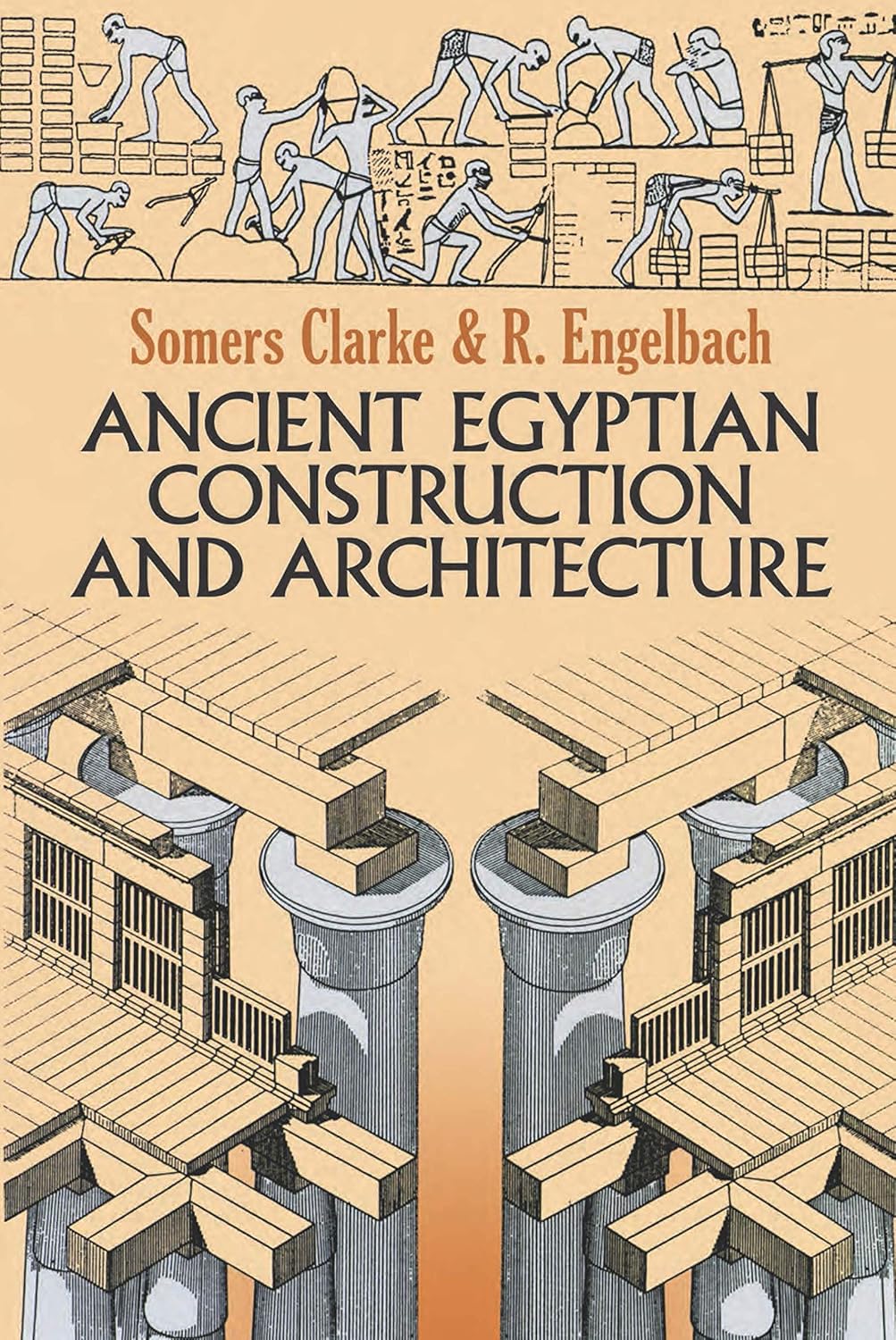
This is a nonfiction book exploring construction methods of the Ancient Egyptians. Yes, they built cool things but... how? How did they quarry the stone, and move it to site, and dress the blocks, and build foundations, etc etc? It's very dry but fascinating, and the Dover edition here is surprisingly full of great illustrations.
Noted on January 20, 2026
The purpose of this volume is to discuss some of the problems incident to the construction of a stone building in ancient Egypt. The material has been drawn partly from the architectural notes made during the past thirty years by the late Mr. Somers Clarke, and partly from my own notes on the mechanical methods known to the Egyptians.
[And later….] It is much to be regretted that, for some months before his death, my late friend and collaborator, owing to a stroke resulting in almost total deafness and blindness, was unable to assist in the final revision of his material and mine; indeed several chapters drawn almost entirely from my notes…
Quoted on January 20, 2026
For instance, it must be realized that the stone quarries were not open to the use of every one, at any rate until late times. The Egyptian world at large appears not to have been permitted to build with stone except in a very restricted manner. The quarrying and working-up of the material seem to have been in the hands of the state. It was natural, therefore, that when methods of work had once been established, the tendency to a hide-bound system, common to all bureaucracies, should develop itself and become crystallized-so thoroughly crystallized that we see, in Egypt, the same things done in the same way from the earliest dynasties down to the period of the Roman occupation, a matter of some 3,500 years.
Quoted on January 20, 2026